Pints, Queues and a Silent Reset: The Twenty-Minute Shift Nobody Clocks
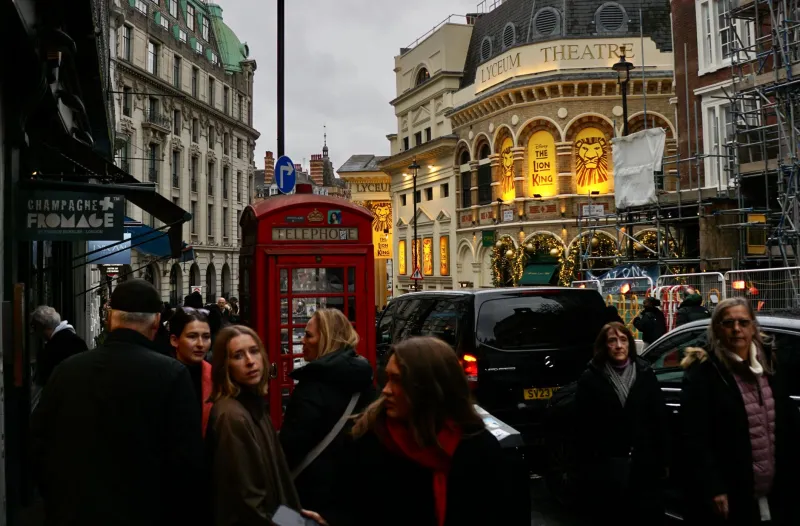
There is a moment, about ninety seconds after the house lights come up, when a theatre stops being a single organism and becomes several hundred small errands. In the West End house I visited on a Thursday, the first wave hits the bar before the last chord has finished ringing. In the touring venue in the Midlands, a fortnight later, the first wave is already queuing for the loo. Either way, the interval has begun, and for the audience it looks like a break. For everyone who works there, it is a shift.
The bell is a starting gun for everyone but the audience
The front-of-house team call it ‘the half’. Not the interval, not the break — the half. It is a unit of labour with a start and an end, and it is planned like one. Before curtain up, the duty manager has already walked the building: bar stock, ice cream freezers, accessible toilet routes, the lift, the cloakroom, the pre-order table. In the West End, pre-ordered drinks are lined up on a trestle with names on stickers. In the touring house, where the bar is smaller and the queue is longer, the plan is simpler: open both tills, put someone on the door, and pray the card machine behaves.
Pre-orders, pints and the mathematics of a toilet queue
The interval is where a theatre’s demographics become very visible. A 1,200-seat West End house on a Thursday might have a school party, three hen dos, a cluster of regulars who know exactly which bar to avoid, and a family with a nine-year-old who needs the loo now. The touring venue on a Saturday matinee is older, whiter, more likely to be carrying a folded programme and a flask. Both audiences want the same things: a drink, a wee, a bit of air, and a sense of not missing anything.
The maths is brutal. A twenty-minute interval with 800 people and six toilet cubicles is not a break; it is a queueing problem. Ushers develop a sixth sense for which staircase will clog first. Bar staff learn to pre-pour the interval favourites — no one wants to be the person who orders an espresso martini at 8.42pm. And the pre-order system, when it works, is a small piece of theatre in itself: the sticker, the tray, the nod, the pint handed over before the card machine has even warmed up.
The silent reset
Backstage, the interval is quieter than you’d think. On a West End show with a big set, the crew have a choreography of their own: a cloth flown out, a truck pushed, a prop table restocked, a quick vacuum of the confetti that shouldn’t be there. In the touring venue, the reset is faster and more improvised — a couple of stage crew, a ladder, a roll of gaffer tape, a note from the company manager about a wobbly chair. No one claps. No one sees it. But the second half depends on it.
I watched a stage manager walk the deck in the touring house with a torch, checking marks. She didn’t say much. She moved a chair two inches left, picked up a bottle cap, and looked at the clock. ‘Half’s not a break for us,’ she said. ‘It’s a deadline.’
Reading the room
The most underrated skill in the interval belongs to front of house. They are not just selling ice cream; they are reading the room. Is that person in the corner crying? Is that child lost? Is the man at the bar too drunk to be served? Is the wheelchair user stuck because someone has parked a buggy in the accessible route? The duty manager is the one who decides whether to hold the second half for two minutes, whether to call a first aider, whether to ask a photographer to stop blocking the aisle.
This is the progressive bit, and it is not abstract. The interval is where access either works or doesn’t. It is where a parent with a buggy finds out if there is space. It is where a neurodivergent audience member decides whether the crowd is too much. It is where a disabled punter discovers whether the accessible loo is actually accessible, or just labelled. The twenty minutes are a stress test for all the good intentions in the building.
When it goes wrong
I’ve seen an interval rescued by a single usher who noticed a queue forming at a closed bar and opened it herself. I’ve seen a touring venue where the card machines went down and the bar staff switched to an honesty box and a clipboard. I’ve seen a West End house where the second half started seven minutes late because a school party had taken the wrong staircase. No one put that in the programme. But everyone in the building felt it.
Why the interval is a labour story
The interval is not a pause in the performance. It is a performance of its own, run by people on zero-hours contracts, split shifts and goodwill. It is the bit where the theatre’s economics become human: the price of a pint, the length of the queue, the number of staff on the bar, the decision to open a second till. It is also the bit where the audience’s behaviour becomes visible — the person who won’t move, the person who will, the person who says thank you.
So next time the bell goes for the second half, listen. That is not just a cue for the audience. It is the sound of a twenty-minute machine switching off, and a lot of people hoping they got it right.