The 2am Colour Match: A Night With the People Who Keep a West End Set Looking New
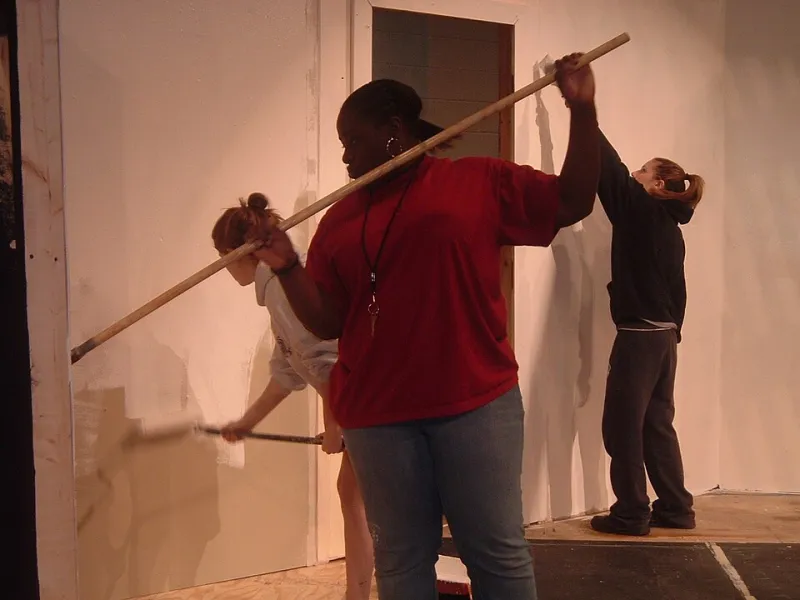
Photo: KeepOnTruckin, Attribution, via Wikimedia Commons
The first thing you learn is that a West End set is not a painting. It is a working surface. It gets walked on, leaned against, sat on, slammed and occasionally wept near. By the time a show has been running for a few years, the set has a patina the original designer never drew: a scuff by the fireplace, a shine on the bannister, a tiny chip in the fake brick where somebody’s shoe caught it during a quick change. The audience is not supposed to see any of it.
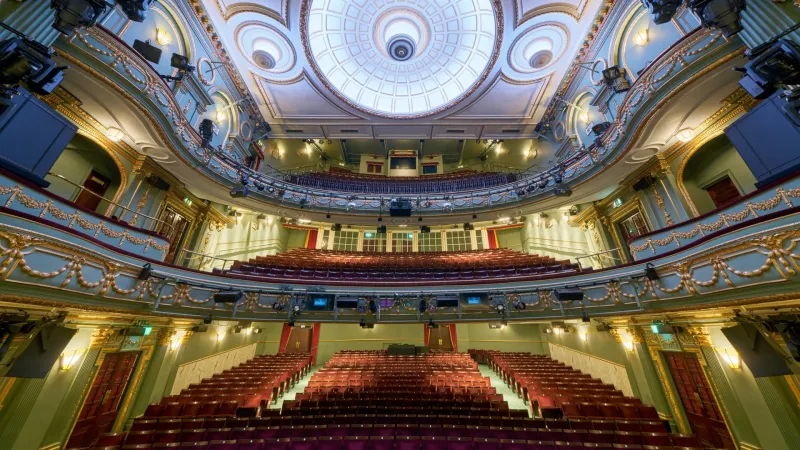
On a wet Tuesday in November, after the evening show has come down, I stand in the stalls of a long-running West End theatre while a scenic artist called — let’s call her M — shines a head torch at a flat that is meant to look like the outside of a Victorian pub. From row F it reads as brick. From two feet away it is a painted surface with a shadow that has started to drift. “That’s the thing nobody tells you,” she says, mixing a small pot of colour on the back of a paint tin. “You’re not matching the brick. You’re matching the light that hits the brick at 7.45pm.”
The hour when the floor starts talking
The stage floor is the first thing to give the game away. A West End floor takes eight shows a week, plus rehearsals, plus the odd photo call. It gets taped, untaped, marked, mopped and danced on. Scenic artists do not just repaint it; they read it. A dark smear near the centre line might be a costume drag. A pale patch by the wing might be where a prop table has been shifted every night for three years. The floor is a diary of the show’s traffic.
“You can’t just slap a coat of the base colour on,” M says, kneeling down with a sponge. “The floor has a map. If you flatten the map, the actors start losing their marks, because the stage feels different under their feet. It sounds mad, but they know. They don’t know they know. But they know.”
She works in small, overlapping patches, blending the new paint into the old with a dry brush. The colour is not a single shade. It is a base, a glaze, a bit of black around the edges and a chalky dusting of something that looks like talcum powder but isn’t. The result is a floor that looks like it has been there for decades. It has been there for four years. That is the trick.
Fake brick and the art of the near-miss
Back at the pub flat, the problem is a mortar line. The original paint job has a soft, slightly irregular line between the bricks — convincing from the audience, because real mortar is never quite straight. But a stage hand has caught the flat with a ladder during a get-out, and now one line is too crisp. Too graphic. It looks like a drawing of a brick rather than a brick.
M mixes a little grey into the white, adds a drop of raw umber, and tests it on a scrap of the same scenic canvas. “You don’t want it perfect,” she says. “Perfect is the enemy. A real wall is boring. A painted wall has to do a job. It has to tell the audience where they are without asking them to look at it.”
She roughens the line with a sponge, then softens it with a dry brush. Then she stands back, squints, and does that thing scenic artists do: she checks it from the back of the stalls, where the audience will actually sit. From there, the repair disappears. From there, the wall is just a wall. That is the whole point.
A colour that only exists under one lamp
Colour matching in the theatre is not like colour matching in a kitchen. You are not painting for daylight. You are painting for a lighting state. The same flat might be hit by a cold wash in act one, a warm special in act two, and a tight follow-spot for the curtain call. The paint has to behave under all of them.
“People think we’re matching to the set,” M says. “We’re matching to the lighting designer’s memory of the set.” She shows me a row of match pots labelled in marker pen: pub wall 2nd act, stair shadow warm, floor scuff — matinee, floor scuff — evening. Some of the colours look almost identical. Some look like they belong in a hospital corridor. All of them have a job.
This is the forensic part of the craft. A scenic artist might spend twenty minutes getting a shadow to sit at the right angle under a specific lamp, because a painted shadow that drifts by two inches can make a doorway look like it is breathing. The audience will not say, “That shadow is wrong.” They will just feel slightly unsettled. And a show that feels slightly unsettled is a show that has lost its grip.
The emergency repair
Not every night is a touch-up. Sometimes it is a rescue. Earlier this season, a stair rail on the set came loose during a Saturday matinee. Nobody was hurt, but the rail was part of the choreography: an actor leans on it, another brushes past it, a third uses it to make an entrance. By the evening show, it had to be fixed — properly fixed, safely fixed, and invisibly fixed.
That means a carpenter first, then a scenic artist. The carpenter makes it strong. The scenic artist makes it look like it was never touched. “You can’t just screw it and go,” M says. “You have to blend the repair into the paint, match the wear, and then check it under the cue that actually hits it. Otherwise you’ve got a solid rail that looks like a patch job. And the audience is paying to believe.”
There is a quiet politics to this labour. The performers get the curtain call. The creative team gets the reviews. The producers get the numbers. The people who keep the set from looking tired are part of the show’s immune system, and they are mostly invisible. That is not a complaint — it is the job description. But it is worth saying: the West End runs on a lot of people whose names are not on the poster.
Why you’re not supposed to notice
“If the audience clocks the paint, we’ve failed,” M says, packing her brushes into a roll. “If they see the fake brick, we’ve failed. If they notice the floor is painted, we’ve failed. The best night for us is the night nobody says anything at all.”
It is a strange kind of success. The work is designed to disappear. A touch-up at 2am is not meant to be a story; it is meant to make sure the story onstage still works at 2.30pm. The audience files in, the lights go down, the fake pub appears, and nobody thinks about the person who spent forty minutes matching a mortar line to a lighting cue. That is the review the scenic artists are after.
By 6am, the paint is dry-ish, the floor is mopped, and the stage manager does a walk-round with a torch. The first front-of-house staff arrive. The pub across the road is getting its delivery. The show will do it all again in a few hours. And somewhere in the wings, a flat that looks like a wall is still slightly wet in one corner. It always is. That is how you know it has been looked after.