Laugh on Cue: The Off-Camera Performers Who Keep a UK Studio Audience Alive
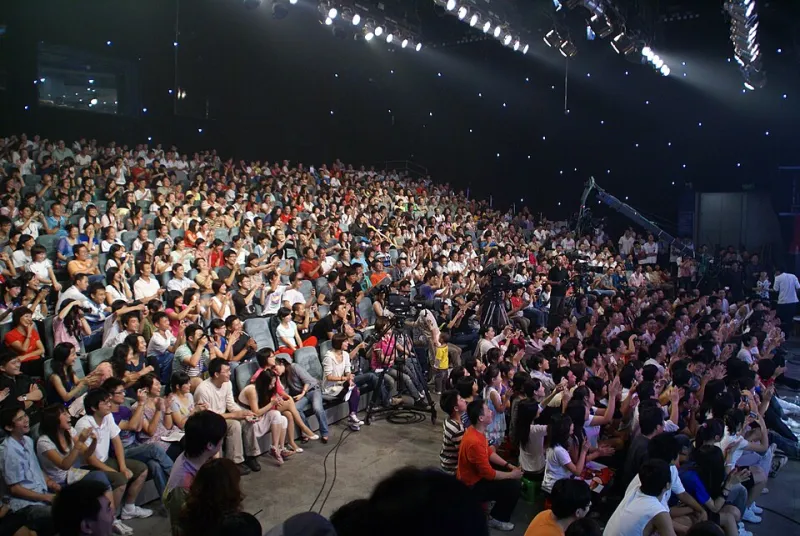
Photo: Plastered T-shirts, CC BY-SA 2.0, via Wikimedia Commons
It is 6.45pm on a damp Tuesday in October 2026, and the queue outside a Salford television studio is doing the familiar shuffle: coat check, phone check, a paper cup of tea, a whispered debate about whether the show will overrun. Inside, Priya Desai is already on the floor. She is not the host, not a producer, not a floor manager. She is the warm-up artist — the performer who works the audience before recording begins and then keeps it alive through every reset, retake and technical hiccup.
“People think I’m there to tell them when to laugh,” she says, crouching by the front row to check a seating issue. “I’m there to make sure they’re okay. If they’re okay, they’ll laugh. If they’re not, no sign on the wall is going to fix it.”
That sign — the illuminated APPLAUSE box that becomes a running joke in every studio audience’s peripheral vision — is, in her words, a backstop, not a script. The real work happens in the gaps: the five minutes before the host walks out, the twelve minutes while lighting is reset, the twenty-minute stretch when a celebrity guest is being powdered and the room starts to sag.
The room before the room
A studio audience is not a single organism. It is a coach party from Wigan, a pair of students who queued for three hours, a family with a teenager who is already bored, a retired couple who remember when television centres had proper canteens. Desai and her peers read that mix quickly. They adjust pace, vocabulary, and risk. A joke about rail replacement buses will land differently in Leeds than in London. A callback to a reality show that finished three years ago may need a one-line explainer. A bit that punches down at a vulnerable group will not be used, no matter how hard the producer laughs.
“You’ve got to know who’s in front of you within about ninety seconds,” says Marcus Bell, a warm-up comic who has worked entertainment, comedy and daytime formats across the UK. “I’ll ask a few easy questions — where people have come from, who’s celebrating something, who’s never been to a recording before. You’re not mining them for material. You’re taking the temperature.”
That temperature check is also a consent check. Warm-up artists are increasingly careful about who gets put on the spot. A disabled audience member should not be turned into a punchline. A neurodivergent punter who does not want to be on camera should not be cajoled. The best warm-ups create permission: you can clap, you can laugh, you can sit quietly and nobody will make you the show.
Reading the room, not the autocue
The craft is part improvisation, part crowd psychology and part diplomacy. Producers want energy. Floor managers want compliance. The audience wants to feel looked after. The warm-up artist is the only person on the floor whose job is to hold all three in the same hand.
“I’m in constant contact with the floor manager,” Desai says. “They’ll give me a look or a hand signal — two minutes, keep going, wrap it up, we’ve got a problem with the set. You learn to read the room and the gallery at the same time. It’s like doing two shows at once.”
Long recording days are the real test. A sitcom records until it is right. A Saturday night show may stop for a costume change, a camera move, a legal note. By the third hour, the audience is tired, the seats are hard, and the air conditioning has either failed or become a wind tunnel. The warm-up artist becomes a human reset button: a quick game, a bit of silly audience participation, a story that gives everyone permission to stretch.
“You can’t just shout ‘more energy’ at people,” Bell says. “You have to give them a reason. Sometimes that’s a rubbish joke. Sometimes it’s acknowledging that yes, this is taking ages, and yes, you’re allowed to be knackered. The audience relaxes when you tell the truth.”
Who speaks for the audience?
There is a quiet ethical dimension to the job. The warm-up artist is freelance, hired by the production, but standing in front of people who have often paid for travel, childcare or time off work. A good warm-up is an advocate as much as an entertainer. They notice when the heating is too high. They flag when a bit has gone too far. They make sure the audience knows where the toilets are and when the break is coming.
Leanne, 34, from Stockport, was in the audience for a comedy recording earlier this autumn. “I was nervous about being picked on,” she says. “But the warm-up guy was really clear: he said nobody has to do anything, and if you don’t want to be on camera, put your hand up. That made a massive difference. I actually enjoyed the waiting bits.”
Another audience member, Tom from Bolton, remembers a recording that ran past midnight. “The warm-up comedian was the only reason we didn’t riot,” he laughs. “He did a whole thing about how we were all in it together. It was daft, but it worked.”
Not a human laugh track
The industry is changing. Streamers record differently. Audiences are more aware of being managed. Some formats now use warm-up artists who double as accessibility hosts, briefing audiences on sensory issues or camera consent. The old model — a bloke with a microphone telling everyone to cheer louder — is giving way to something more nuanced.
“It’s emotional labour,” Desai says. “You’re holding a room. You’re not forcing it. You’re not faking it. You’re just making it possible for people to have a good time after a long day.”
When the recording finally ends, the audience files out into the Salford rain. Desai stands by the exit, saying goodnight, answering directions, taking the occasional selfie. The cameras are off. The applause sign is dark. The performance is over — except it never really was one.